ASCE 7-22 and the California Building Code require site-specific seismic hazard analysis when a project falls within a deep alluvial basin like the southern San Joaquin Valley. Visalia sits on unconsolidated Quaternary sediments deposited by the Kaweah River, and basin-edge effects can amplify long-period ground motion more than a standard probabilistic hazard map suggests. Over the past decade, the city has annexed land east toward the Sierra foothills and west into lower-lying agricultural parcels near Goshen — both settings have different shear-wave velocity profiles and liquefaction susceptibility. A seismic microzonation study maps those differences block by block, combining in-situ MASW surveys with borehole data and laboratory dynamic testing. For city planners and structural engineers, the result is a set of ground-motion parameters that feed directly into foundation design, retrofit prioritization, and emergency response planning. The engineering team in Visalia typically couples microzonation work with an SPT drilling campaign to calibrate Vs profiles against N-values, especially where the water table is shallow and the upper 30 meters show interbedded silts and fine sands. This interplay between geophysical and geotechnical data is what turns a regional hazard map into a site-scale decision tool.
Visalia's basin geometry can amplify ground motion at periods of 0.5–1.5 seconds, which matters for mid-rise structures that a generic Site Class D spectrum would not capture.
Scope of work in Visalia
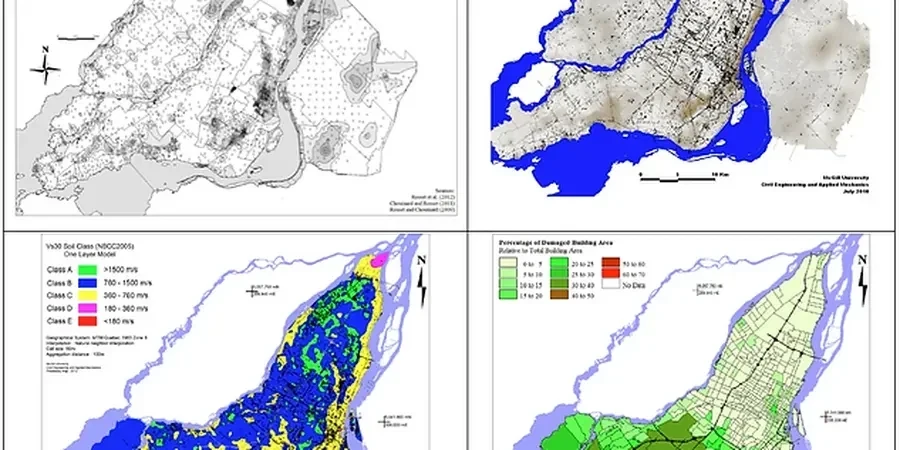
Local geotechnical conditions in Visalia
The summer-to-winter contrast in soil moisture across the eastern Valley changes near-surface Vs by 10–15 percent, which means a survey run in August on dry, cracked clay will not match a February dataset on the same parcel. Visalia's irrigation network — canals, retention basins, and shallow perched water — compounds the problem, creating localized soft zones that a regional hazard map averages out. The biggest risk from skipping microzonation is a misclassified site class: a parcel that looks like stiff soil on a county-scale map can turn out to be soft clay with a fundamental period close to the resonance frequency of a three-story building. That mismatch leads to underestimated base shear and drift, and in a moderate event on the White Wolf or Kern Canyon faults it can mean the difference between repairable cracking and structural failure. For subdivision-scale projects, microzonation also identifies areas where liquefaction assessment must be coupled with the ground-motion analysis — particularly in the low-lying tracts west of Plaza Drive where the water table is within 2 m of the surface and the fines content is borderline.
Our services
The Visalia office structures each microzonation study around the specific decision the client needs to make — whether it is a land-use plan, a retrofit priority list, or a foundation design. Three core service packages cover the most common scenarios in Tulare County.
Code-Compliant Site Classification
MASW lines plus targeted SPT borings to assign NEHRP site class and design spectra for individual parcels. Delivered as a signed report meeting CBC and ASCE 7 requirements for plan check submittal.
Subdivision-Scale Microzonation
Grid-based Vs30 mapping over 10–500 acres, including fundamental-period contours and liquefaction-susceptibility overlay. Used by civil engineers to phase earthwork and by the city to update safety elements of the general plan.
Critical-Facility Ground-Motion Analysis
Site-specific response spectra, time-history selection, and soil-structure interaction parameters for Risk Category III and IV structures — hospitals, schools, emergency operations centers — where the IBC requires a probabilistic or deterministic site-specific study.
Top questions
What does a seismic microzonation study cost for a typical Visalia commercial lot?
For a single commercial parcel under 2 acres, the study generally ranges from US$3,840 to US$7,200, depending on the number of MASW lines and whether calibration borings are required. A subdivision-scale study over 20–50 acres with multiple transects and a liquefaction overlay typically falls between US$9,500 and US$16,770, with the final figure driven by the grid resolution and the depth of investigation needed to reach competent rock or stiff sediments.
How does Visalia's basin geology affect the results compared to a standard code spectrum?
The deep alluvial fill of the San Joaquin Valley traps and amplifies seismic energy, particularly at periods between 0.5 and 1.5 seconds. A standard CBC Site Class D spectrum does not capture these basin-edge effects. Microzonation measures the actual shear-wave velocity profile at the site and computes a response spectrum that accounts for impedance contrasts at depth, often producing higher spectral accelerations at mid-range periods than the default code envelope.
How many MASW lines does the City of Visalia typically require for a new subdivision?
The city does not prescribe a fixed number of lines; it follows CBC Section 1613, which requires enough investigation points to characterize site variability. For a 40-acre subdivision in Visalia, the engineering team usually runs transects on a 100–150 m grid, with tighter spacing near mapped paleochannels or areas where the water table is shallower than 3 m. The exact layout is agreed upon during the geotechnical peer review scoping meeting.
Can microzonation results be used to reduce foundation costs?
In some cases, yes. If the study demonstrates that a parcel has a stiffer profile than the default Site Class D — for example, Site Class C with Vs30 above 360 m/s — the design base shear can be reduced, which may allow lighter foundation sections or fewer piles. The report must still be accepted by the structural engineer of record and the plan-check authority, but the site-specific spectrum is permitted by ASCE 7-22 as an alternative to the mapped values.