When our rig arrives at a site near the St. Johns River, the first sound you hear is the automatic hammer of the SPT sampler driving a split spoon into the subsurface. In Visalia, where the water table can sit just 10 to 15 feet below the surface through much of the year, those blow counts tell a story that goes well beyond bearing capacity. The combination of Holocene alluvium deposited by the Kaweah River and a shallow groundwater profile means that loose, saturated sands are a common encounter here.
We run the Standard Penetration Test following SPT drilling protocols to gather the raw data, then apply corrections for overburden pressure and energy ratio before feeding everything into a liquefaction triggering model. The analysis follows the NCEER workshop framework, which remains the most widely accepted procedure for quantifying cyclic stress ratio versus cyclic resistance ratio. For sites where continuous stratigraphic detail is critical, we also deploy CPT testing to capture sleeve friction and pore pressure data at centimeter-scale resolution.
A factor of safety below 1.1 at a single depth interval can trigger settlement estimates exceeding six inches, which changes the foundation strategy entirely.
Scope of work in Visalia
Our evaluation starts with site characterization per ASTM D1586 and ASTM D2487, classifying each stratum by grain size, fines content, and plasticity. Those parameters control the cyclic resistance of the soil, and small differences in fines content can shift a layer from liquefiable to non-liquefiable. We calculate factor of safety against liquefaction at one-foot depth intervals, then estimate post-liquefaction settlement using the Tokimatsu-Seed or Ishihara-Yoshimine procedures. The output is a settlement map that tells the structural engineer exactly where differential movement may occur. When the project footprint includes areas with marginal factors of safety, integrating findings from a seismic microzonation study helps refine the ground motion inputs and avoid overconservative designs that drive up foundation costs unnecessarily.
Local geotechnical conditions in Visalia
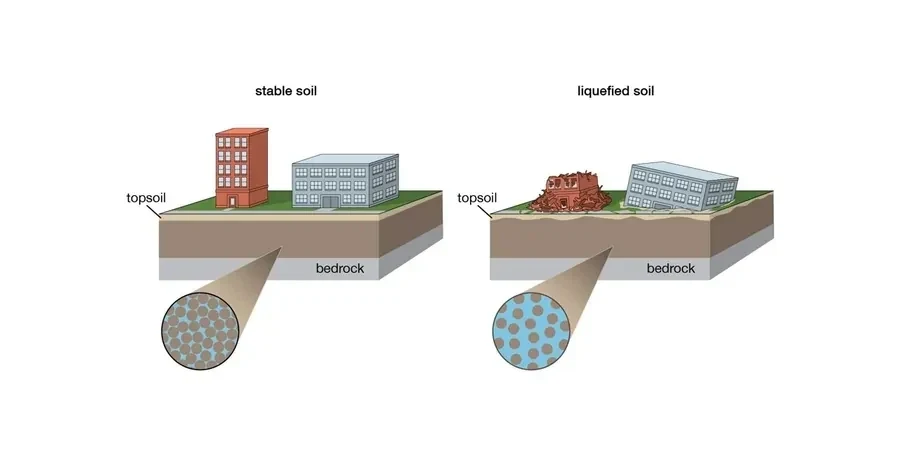
One pattern we observe repeatedly in Visalia is the lens-shaped sand bodies trapped within otherwise stiff clay profiles. A contractor drilling for a warehouse foundation near the industrial corridor off Plaza Drive hits dense clay for fifteen feet, assumes the profile is competent, and never runs a liquefaction check. The problem is the thin saturated sand lens at eighteen feet that goes undetected because standard exploration terminated too shallow. During a moderate earthquake on the Sierra Nevada frontal fault system, that lens can liquefy, drain upward, and produce surface settlement cracks that undermine slab-on-grade performance. The repair costs for differential settlement in a tilt-up concrete building routinely exceed six figures. A proper liquefaction analysis extends borings to at least fifty feet or until a competent bearing stratum is confirmed, and it correlates every sample with laboratory grain-size data so no thin layer escapes classification. Ignoring the depth requirement because the structural loads appear light is a gamble that has not paid off in the Central Valley's alluvial environment.
Our services
A liquefaction evaluation in Visalia rarely stops at a yes-or-no determination. The practical question is always: what do we do about it? Our analysis package includes the supporting works that turn a geohazard finding into an actionable foundation design.
SPT-based liquefaction triggering analysis
Complete evaluation per NCEER simplified procedure using field SPT data corrected for hammer energy, overburden, and fines content. Deliverables include factor of safety logs and post-liquefaction settlement estimates at one-foot depth intervals.
Laboratory fines content and plasticity testing
Grain-size distribution per ASTM D1140 and Atterberg limits per ASTM D4318 on every potentially liquefiable sample. Fines content corrections follow the revised Youd-Idriss (2001) curves, which differ significantly from the original Seed (1985) recommendations for high-plasticity silts.
Liquefaction-induced settlement and lateral spreading assessment
Settlement calculations using Tokimatsu-Seed and Ishihara-Yoshimine methods, plus lateral spreading displacement estimates per the Bartlett & Youd (1992) empirical model. Results are plotted on site plan overlays for direct use by the structural and civil design team.
Top questions
What is the typical cost for a soil liquefaction analysis in Visalia?
For a standard commercial lot in Visalia, a complete liquefaction analysis including two to four SPT borings, laboratory grain-size and Atterberg testing, and the engineering report typically ranges from US$2.850 to US$4.210 depending on depth, number of samples, and whether CPT soundings are added for stratigraphic refinement.
How deep do borings need to go for a valid liquefaction assessment?
In the Visalia area, we generally extend borings to a minimum of 50 feet below grade or until a competent non-liquefiable stratum is confirmed. The 2022 CBC requires that all potentially liquefiable Holocene-age deposits be investigated, and in the Kaweah River alluvial basin these can extend to depths exceeding 60 feet in some locations.
Does Visalia have a high seismic risk for liquefaction?
Visalia sits in the San Joaquin Valley basin, where thick sequences of loose alluvial sands and a shallow groundwater table create moderate to high liquefaction susceptibility. While the city is not directly on the San Andreas Fault, it can track record strong shaking from Sierra Nevada frontal faults and distant large-magnitude events, making liquefaction a design-relevant hazard for Seismic Design Category D structures.
What soil types are most susceptible to liquefaction in the Visalia area?
Clean to silty sands (SP and SM per USCS) with relative densities below 60% and fines contents under 35% are the primary liquefaction-prone materials in Visalia. These soils dominate the younger alluvial fan deposits east of Highway 99. Silty gravels (GM) and low-plasticity silts (ML) can also liquefy under strong shaking, which is why we run plasticity tests on every sample rather than relying on field classification alone.