Visalia’s growth from railroad stop to San Joaquin Valley agricultural hub brought steady construction across alluvial fans where loose sands and silty sands dominate. The Kaweah River and deep groundwater shaped these deposits over millennia, leaving soils that can settle unevenly under load or lose strength during seismic shaking. Projects on the east side, closer to the Sierra foothills, often hit granular lenses that densify well with deep vibration. Our vibrocompaction design service addresses exactly that—turning problematic loose zones into competent ground before structural loads go in. The approach saves time compared to over-excavation and works within the Valley’s tight construction windows between harvest seasons. For sites where grain-size distribution is borderline, we often pair the design with a grain-size analysis to confirm suitability before mobilizing the vibrator probe.
Deep vibratory compaction turns loose alluvial sand into a stiff soil mass that resists settlement and drains excess pore pressure during an earthquake—a direct investment in foundation performance.
Scope of work in Visalia
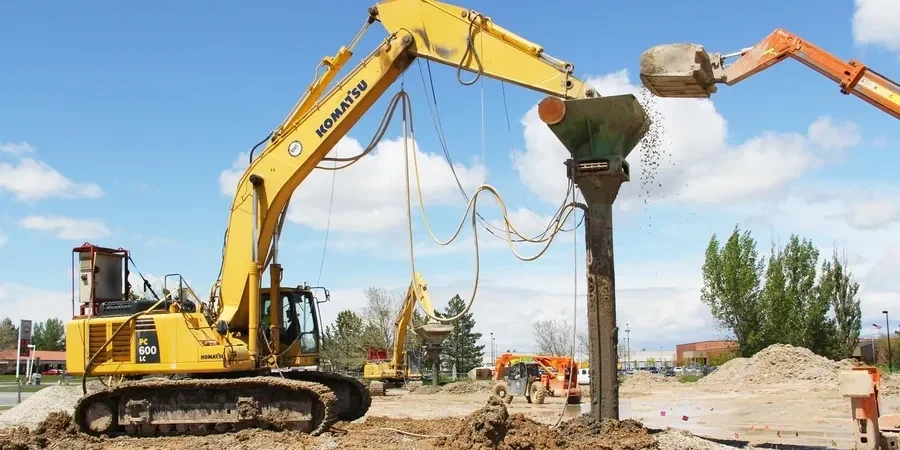
Local geotechnical conditions in Visalia
On Visalia’s west side, we frequently encounter layered profiles where a thin silt crust overlies clean sand—and that crust can block pore-pressure dissipation during vibration if not pre-treated. The result is a zone that looks treated from the surface but remains loose at depth. Our design approach includes pilot testing at two or three probe locations to map the exact depth of silt lenses, adjusting jetting pressure and hold time before full-scale treatment begins. Another risk specific to the Valley is seasonal groundwater fluctuation; a design calibrated in October, when the water table is low, may underperform in March after heavy Sierra runoff raises the phreatic surface. We schedule verification CPT testing within 48 hours of treatment to confirm that the design parameters held true under the actual groundwater condition at the time of work.
Our services
Our vibrocompaction design package includes the field investigation, treatment layout, and post-densification verification required by Visalia building officials.
CPT-based densification design
We use cone penetration test data to identify treatable granular layers and to set probe spacing, vibration hold time, and target depth for each treatment point.
Grid layout and sequencing plan
Triangular grid with primary and secondary passes, stamped by a California-licensed engineer, ready for contractor execution.
Real-time QC monitoring protocol
Ammeter draw, penetration rate, and water pressure logged continuously to confirm each probe location meets the design energy input.
Post-treatment verification testing
CPT or SPT borings within 48 hours of compaction, comparing pre- and post-treatment tip resistance to document density improvement.
Top questions
What Visalia soil types respond best to vibrocompaction?
Clean to slightly silty sands with less than 15 percent fines passing the No. 200 sieve respond best. The alluvial sands deposited by the Kaweah River and its distributary channels are ideal candidates. Soils with higher fines content may require a different technique—we evaluate grain-size curves before recommending vibrocompaction.
How much does vibrocompaction design cost for a typical Visalia commercial lot?
Design fees generally range from US$1,550 to US$4,910, depending on the treatment area size, number of CPT soundings required, and the complexity of the grid layout. A half-acre commercial pad with straightforward soil conditions falls toward the lower end; larger industrial sites needing multiple verification borings reach the upper range.
How long does the design and approval process take in Visalia?
Field investigation takes two to three days. The design report with stamped drawings is typically delivered within five to seven business days after lab data is complete. Visalia’s Building & Safety Division reviews Improvement submittals as part of the foundation permit package—turnaround depends on their current workload, but the technical package we deliver is formatted to match their checklist.