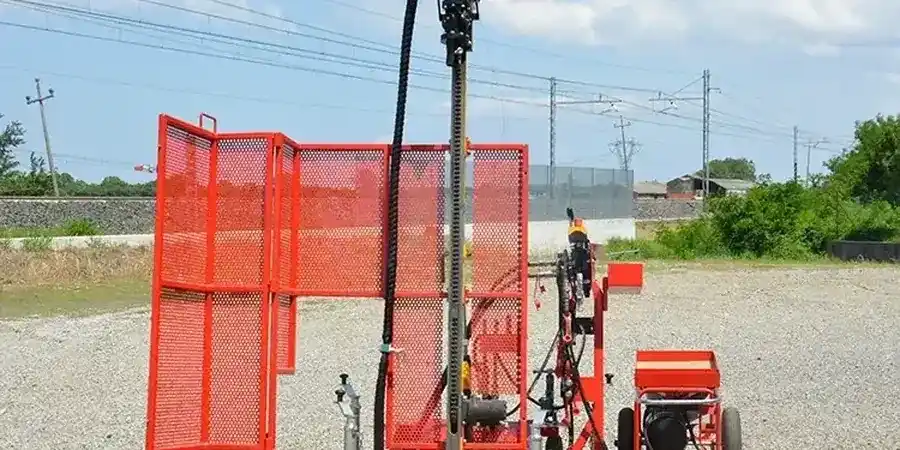
The split-spoon sampler drives into the ground under the weight of a 140-pound hammer, dropping 30 inches per blow. In Visalia, where alluvial soils and shallow groundwater can complicate site preparation, the SPT (Standard Penetration Test) gives you the N-value data engineers need to design foundations that hold up. We run the SPT with a CME-75 drill rig that handles the sandy loams and clay layers common across Tulare County. Each 18-inch increment of penetration gets logged, bagged, and tagged according to ASTM D1586, so your geotechnical report comes with numbers you can trust. Before breaking ground on a new commercial building near Mooney Boulevard or a warehouse out by Highway 99, pairing the SPT with a CPT test can give you a continuous soil profile that complements the discrete SPT samples, especially in the mixed fills found around older parts of Visalia.
An SPT in Visalia soils delivers more than a blow count: it gives you a disturbed sample you can see, feel, and classify, which matters when the alluvial stratigraphy changes every few feet.
Scope of work in Visalia
Working video
Local geotechnical conditions in Visalia
Visalia sits at an elevation of about 331 feet, on the alluvial plain east of the Coast Ranges, roughly 200 miles from the San Andreas Fault. The city has felt shaking from events like the 1983 Coalinga quake and the distant but potent 1857 Fort Tejon rupture. The California Geological Survey maps portions of the San Joaquin Valley with moderate to high liquefaction susceptibility, particularly where loose, saturated sands exist within 50 feet of the surface. An SPT program that measures blow counts in these sandy layers, combined with fines content from a sieve analysis, gives your project the data needed to run a liquefaction triggering analysis using the NCEER methodology. Skipping this step on a site with shallow groundwater near the St. Johns River could leave a warehouse or apartment complex vulnerable to settlement during a design-level seismic event, a risk that retrofitting won't fix cheaply after construction.
Our services
Each SPT we run in Visalia feeds into a broader geotechnical investigation tailored to the Central Valley's soil profile. The works below represent the most common requests we combine with SPT data to deliver a complete foundation report.
Borehole Drilling and Sampling
We use truck-mounted CME-75 drill rigs to advance boreholes through Visalia's alluvial deposits, retrieving split-spoon samples at 5-foot intervals or at every stratigraphic change as required by the project geotechnical engineer.
N60 Correction and Liquefaction Analysis
Raw N-values are corrected for overburden pressure, hammer energy ratio, and borehole diameter. We run liquefaction triggering analyses per NCEER guidelines for sites with shallow groundwater near the St. Johns River corridor.
Laboratory Index Testing Package
Disturbed SPT samples undergo moisture content, Atterberg limits, and sieve analysis in our AASHTO-accredited lab to confirm soil classification and support bearing capacity calculations.
Geotechnical Report with Foundation Recommendations
A signed, stamped report summarizing subsurface conditions, corrected N60 profiles, allowable bearing pressures, and settlement estimates for shallow or deep foundation options in Visalia.
Top questions
How much does an SPT boring cost in Visalia?
For a single SPT boring in the Visalia area, you can expect to budget between US$620 and US$700. The final cost depends on the total depth, the number of SPT intervals, and whether we need to set up on pavement or across irrigation ditches common in Tulare County.
How many SPT borings does my Visalia project need?
The IBC requires at least one boring for every 2,500 square feet of building footprint for structures up to three stories, with a minimum of two borings per site. For a typical commercial lot along Demaree Street, that usually means three to five borings spaced to capture variability across the parcel.
What depth do you drill for an SPT in Visalia?
Most SPT borings in Visalia go to 25 or 50 feet below grade, which is deep enough to penetrate the alluvial soils and reach the older, stiffer deposits that deliver reliable bearing. For projects with deeper basements or heavy column loads, we can extend to 75 feet or more.
How long does it take to get the SPT results back?
Field logs with blow counts and sample descriptions are available the same day as drilling. The full geotechnical report with corrected N60 values, lab test results, and foundation recommendations typically takes five to seven business days after the field work is complete, depending on the lab testing queue.