Visalia sits at an elevation of about 331 feet, perched on the edge of the San Joaquin Valley where alluvial fans from the Sierra Nevada meet the valley floor. That transition zone creates a subsurface profile that can shift from dense sands to soft silts within a single lot. Any foundation design here has to reckon with that variability. Our team has run CPT soundings across the city, from the newer developments near the Visalia Municipal Airport to the historic neighborhoods around downtown, and the data consistently shows that a borings-only approach misses critical soft layers. When you combine the grain-size analysis of thin-walled samples with continuous CPT pore pressure readings, you start to see the real picture—one that static penetration resistance alone can’t deliver. For projects where seismic performance matters, pairing CPT data with seismic-microzonation insights helps engineers anticipate how the site class will respond during a design-level event.
Continuous CPT profiling reveals thin soft seams that standard SPT spoon recovery misses entirely—critical in Visalia’s layered alluvial deposits.
Scope of work in Visalia
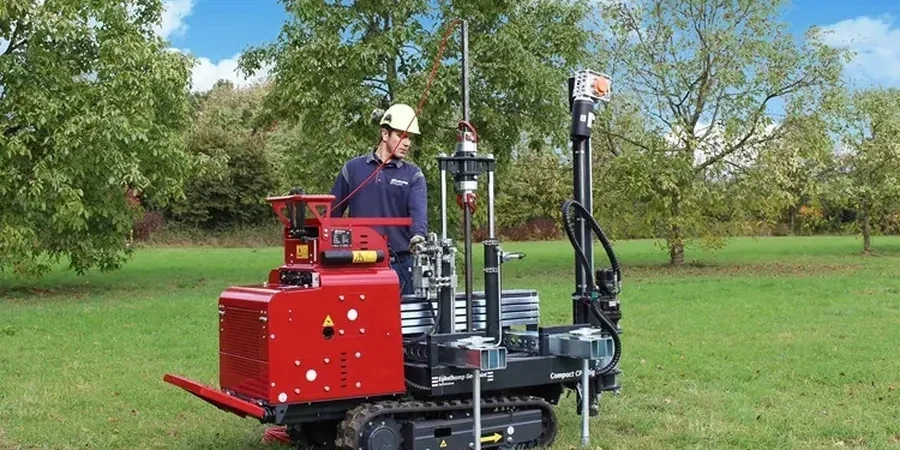
Working video
Local geotechnical conditions in Visalia
The Central Valley’s hot, dry summers and occasional wet winters influence CPT operations in Visalia more than people expect. In late summer, the upper vadose zone can be bone-dry, and pushing through dessicated crust requires higher thrust capacity. When winter storms arrive, those same soils turn slick and the access conditions can deteriorate fast. Beyond logistics, the real risk is misinterpreting unsaturated zone data. A high tip resistance in dry silt can look deceptively like a competent sand, and if you don’t have pore pressure data or a moisture log to cross-check, you can end up with an overoptimistic bearing capacity estimate. That’s why we run pore pressure dissipation tests at multiple depths on every Visalia job—even when the client doesn’t explicitly request them. The city’s position in Seismic Design Category D under the IBC means a misclassified site class has real consequences for structural design loads.
Our services
We offer two targeted CPT-based service packages for Visalia projects. Each can be adjusted to the lot size, access constraints, and depth requirements of your site.
Standard CPT with Pore Pressure
Continuous seismic cone penetration testing to 60 ft, including dynamic pore pressure measurement and dissipation tests at three depths. Delivered with a classified soil behavior type log and normalized parameters.
CPT for Liquefaction Assessment
Targeted CPT program for evaluating liquefaction susceptibility under the M7.9 design earthquake scenario. Includes cyclic resistance ratio analysis and post-liquefaction settlement estimates per the NCEER method.
Top questions
How does CPT compare to standard SPT drilling in Visalia's soils?
The CPT provides a continuous vertical profile rather than discrete samples every 5 feet. In Visalia’s layered alluvium, this means we catch thin silt seams that SPT spoon recovery can miss entirely. The CPT also measures dynamic pore pressure, which helps identify partially drained soils common on the east side of town. SPT still has value when you need a physical sample for index testing, so many projects use both methods together.
What depth can you reach with CPT in the Visalia area?
Most of our Visalia CPT soundings reach 60 to 80 feet below grade, depending on soil density and the thrust capacity of the rig. In the coarser deposits west of Mooney Boulevard, refusal can occur earlier if we encounter a dense gravel layer. We always push until refusal or the target depth, and we’ll advise on alternative methods if CPT can’t reach the required depth on your lot.
What does a CPT test cost for a residential lot in Visalia?
A standard CPT sounding with pore pressure measurement on a residential lot in Visalia typically runs between US$180 and US$270 per sounding, depending on depth, access conditions, and whether dissipation tests are included. Larger commercial projects with multiple soundings benefit from reduced per-location pricing. We deliver a written quote after reviewing the site address and project scope.
How soon can I get the CPT report after the field work?
We typically deliver the digital CPT log with soil behavior type classification within 48 hours of the field work. If you need interpreted parameters—equivalent SPT N-values, undrained shear strength, or constrained modulus—that adds an extra day. For rush projects, we can turn around a preliminary log the same evening. The final signed report includes all raw data files and the engineer’s interpretation notes.