In Visalia, retaining walls do more than hold back earth—they manage the subtle challenges of deep alluvial deposits from the Kaweah River basin. The city sits on a mix of sandy loams and clays that can lose strength when saturated, making drainage a critical design factor. Many projects here, from residential subdivisions near the St. Johns River to commercial cut-fill operations, require a retaining wall design that accounts for both short-term construction loads and long-term settlement. We incorporate local groundwater data and soil parameters obtained from in-situ permeability testing to size weep holes and drainage blankets correctly. For walls exceeding six feet or supporting surcharge loads, the analysis extends to global stability, often linking back to a broader slope stability evaluation of the adjacent grade.
Effective retaining wall design in the Central Valley starts with accurate effective stress parameters and a drainage plan that accounts for seasonal irrigation runoff.
Scope of work in Visalia
The result is a set of calculations that translate site-specific data into practical reinforcement details, drain specifications, and compaction requirements for the backfill zone. Each design package includes construction sequence notes because staged backfilling can reduce temporary bracing costs significantly on taller structures.
Local geotechnical conditions in Visalia
ASCE 7-22 and the California Building Code (IBC Chapter 18) demand explicit seismic earth pressure increments for walls in Seismic Design Category D, which covers most of Visalia. Ignoring the dynamic component can lead to rotational failure during a moderate event on the nearby San Andreas or Owens Valley fault systems. The risk is compounded when walls retain saturated silts; cyclic loading can trigger excess pore pressure and a sudden loss of passive resistance. Our retaining wall design addresses this through Mononobe-Okabe analysis, coupled with liquefaction screening of the foundation soil when groundwater is within 50 feet of the base. We also evaluate global compound failure surfaces that extend behind the reinforced zone, a check that becomes mandatory for tiered walls or those with steep backslopes. The cost of this analysis is negligible compared to the liability of a wall that displaces even a few inches under seismic load.
Our services
Retaining wall design in Visalia spans several structural and geotechnical disciplines. The four service areas below cover the typical project scope from initial investigation through construction support.
Site Investigation for Wall Design
Targeted SPT borings and test pits to define the retained soil profile, foundation bearing stratum, and groundwater depth. We log according to ASTM D2488 and collect undisturbed samples for laboratory strength testing.
Cantilever & Gravity Wall Analysis
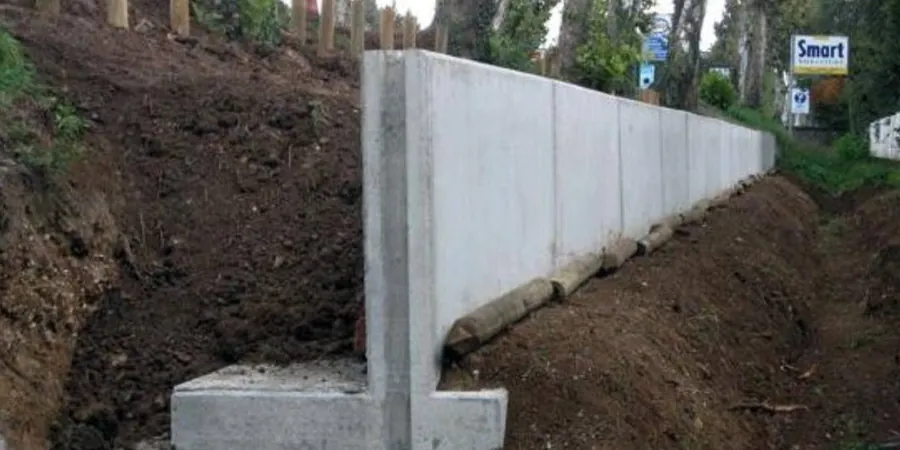
Computational models for reinforced concrete cantilever, gravity, and crib walls. We output stem and heel reinforcement schedules, bearing pressure distributions, and global stability cross-sections for agency review.
MSE Wall & Segmental Block Design
Design of mechanically stabilized earth walls using geogrid reinforcement. Includes pullout capacity calculations, facing connection checks, and internal compound stability per AASHTO LRFD for walls over 12 feet.
Construction Support & Observation
On-site verification of foundation bearing material, backfill compaction testing (nuclear gauge), and drain installation. We deliver stamped as-built letters confirming conformance with design documents.
Top questions
When is a retaining wall design required in Visalia instead of a standard detail?
A custom design is triggered when the wall exceeds 4 feet in height, supports a surcharge (driveway, pool, adjacent structure), or is founded on fill or soft clay. The City of Visalia Building Division reviews these under IBC Section 1807. We prepare sealed calculations and drawings for submittal.
What does retaining wall design cost for a typical residential project in Visalia?
For a single-family residential wall under 8 feet tall, the design fee typically ranges from US$1,190 to US$3,840, depending on the number of soil borings required and whether a drainage study is included. Taller walls, tiered configurations, or those supporting heavy surcharge require more analysis and are priced accordingly.
How do you handle expansive clay backfill in a retaining wall design?
We specify a select granular backfill zone extending at least 2 feet behind the wall face. The material must have a plasticity index below 15 and pass ASTM D4318 testing. A geotextile filter fabric separates this zone from native expansive soil, and the drainage system is designed to keep moisture content stable.
How long does the design and permitting process take in Visalia?
Once the site investigation is complete, we deliver design drawings within 10 to 14 working days. City of Visalia plan review for retaining walls typically adds two to three weeks. We coordinate directly with the building department to address any plan check comments without delaying your project schedule.