Working with soils from the eastern edge of the San Joaquin Valley, our lab team sees a lot of samples that change character completely between the dry season and the first winter rains. Visalia sits at roughly 330 feet elevation, where the transition from coarse alluvial fans near the Sierra foothills to finer basin deposits creates a patchwork of silty clays and clayey silts. The Atterberg limits test is often the first real clue we have about how a particular soil will behave under moisture fluctuation. Knowing the liquid limit and plastic limit is not just a classification exercise — it tells us whether a footing excavation in the northwest part of town will hold its shape after a storm, or whether the material will turn into sticky muck. We run these tests almost daily in our Visalia lab, and we have learned that the local soils rarely fit the textbook perfectly.
When we see liquid limits climbing above 45 on a sample from a commercial site near Mooney Boulevard, we immediately think about volume change potential and how it ties into the liquefaction analysis if the water table is shallow.
A plasticity index above 25 in a Visalia clay is not just a number — it is a warning that the soil will move seasonally enough to crack grade beams if left unaddressed.
Scope of work in Visalia
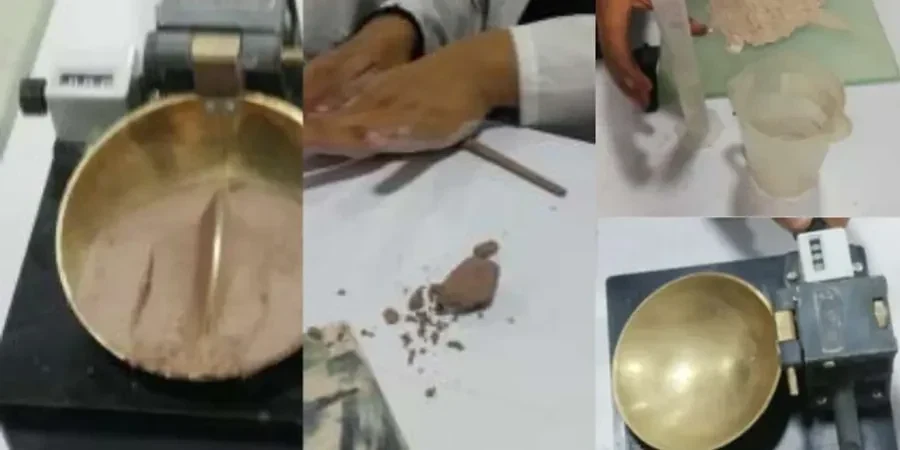
Working video
Local geotechnical conditions in Visalia
The risk profile of a project changes significantly between the sandy loams found near the Visalia Municipal Airport and the heavy clays mapped south of the St. Johns River. In higher ground, we often see low-plasticity silts that drain reasonably well, and the Atterberg limits come back with PI values under 12 — manageable for standard shallow foundations. In the lower-lying basin areas, the same test can return a PI of 28 or more, and that soil will expand when wetted and shrink when dried, generating differential movement that can shear utility connections. We have seen projects where ignoring the plasticity data led to slab curling within two years of construction. The Atterberg limits also feed directly into the empirical correlations we use for slope-stability analysis on irrigation canal embankments east of town, where a thin layer of high-plasticity clay can form a failure plane after prolonged saturation.
Our services
Our Visalia soil mechanics laboratory provides Atterberg limits testing as part of a broader geotechnical characterization package. Each of the following works is performed in-house under the same quality system.
Full Atterberg Limits Suite
Multipoint liquid limit (Casagrande cup), plastic limit (hand-rolling), and shrinkage limit determination with oven-dried pats. Delivered with USCS classification and a comparison chart of regional typical values.
One-Point Liquid Limit & Plastic Limit
Expedited testing for projects with limited recovered sample mass, using the one-point method validated against the flow curve for Visalia-area CH and CL soils.
Plasticity Index & Expansion Potential Report
Interpretive report correlating PI, activity, and clay mineralogy to probable swell-shrink behavior under Visalia's seasonal moisture regime, with foundation recommendations.
Top questions
How much does Atterberg limits testing cost for a Visalia project?
For a standard liquid limit and plastic limit determination on a single sample from the Visalia area, laboratory fees generally range from US$60 to US$90, depending on whether the multipoint method or one-point method is used and how quickly results are needed.
What is the difference between liquid limit and plastic limit in practical terms?
The liquid limit is the moisture content at which soil passes from a plastic state to a liquid state and the groove in the Casagrande cup closes after 25 blows. The plastic limit is the moisture content at which the soil crumbles when rolled into 3 mm threads. Together they define the plasticity index, which governs how much water the soil can absorb before losing strength.
Why do Visalia clays often show high plasticity indices?
Many of the finer basin deposits in the Visalia area contain smectite-group clay minerals derived from weathered Sierra Nevada granitic rocks. These minerals have high specific surface area and strong affinity for water, which pushes the liquid limit above 50 and the plasticity index above 25 in numerous samples we process.