Visalia’s growth from a farming town to a San Joaquin Valley hub put a lot of pressure on its alluvial soils. When a city sits on deep deposits of sandy silts and clays laid down by the Kaweah River, you learn quickly that structural integrity starts with what’s under the slab. In our track record, the single most common call after a failed density inspection is for a Proctor test. Whether it’s a tilt-up warehouse off Highway 99 or a new school wing near Mooney Boulevard, the lab curve defines what the field crew has to hit. We run both Standard and Modified Proctor tests in our Visalia soil lab, because the right energy input depends entirely on the project’s structural load and the owner’s specification. A badly chosen reference density leads to either wasted over-compaction effort or settlement-prone fill, and in a region where summer heat bakes the moisture out of borrow material by 10 a.m., the field-moisture side of the curve matters as much as the dry density peak. Before we even fire up the hammer, we often cross-check the gradation with a grain-size analysis to spot fines content shifts that can invalidate a textbook Proctor family of curves.
A Proctor curve built on oven-dried material can overstate the optimum moisture by two percentage points, which in Visalia summer conditions is the difference between passing density and a re-compaction order.
Scope of work in Visalia
Local geotechnical conditions in Visalia
A few years back we were called to a Visalia retail pad on the east side where the contractor had placed about four feet of engineered fill using a borrowed curve from a Caltrans job in Fresno. The field density tests kept failing, the roller was making thirty passes, and the moisture was a moving target. When we ran a site-specific Proctor on the actual borrow, the optimum was two percent higher than the borrowed curve, and the maximum dry density was almost six pounds lower. They had been chasing a number that didn’t belong to their soil. We see this in Visalia more often than you’d think, especially when developers move dirt between sites on the north and south sides of town where the clay fraction changes subtly with the old river channel deposits. The risk isn’t just a failed inspection—it’s differential settlement under floor slabs, cracked partition walls, and utility trenches that sag after the first wet winter. For any project over a few thousand square feet, we recommend running at least one Proctor per distinct borrow source, and if the site has been leveled with import fill from multiple origins, test each one separately. A $150 lab test is a cheap hedge against re-compacting a slab subgrade in the middle of August.
Our services
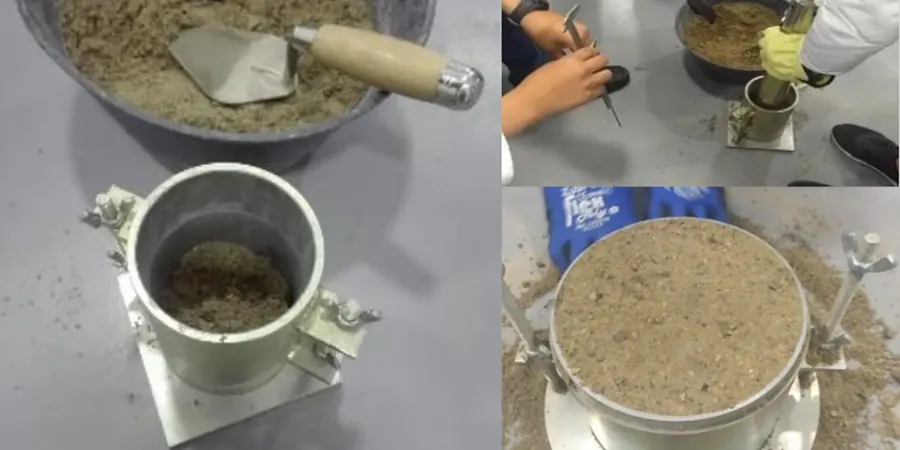
Over the years we’ve built a lab workflow in Visalia that handles the volume of a busy construction season without cutting corners. Our Proctor service covers the whole project timeline:
Standard Proctor (ASTM D698)
Four- to five-point moisture-density curve for building pads, residential slabs, and light commercial fill. Sample from the actual borrow source, compacted at field moisture and corrected for gravel content.
Modified Proctor (ASTM D1557)
Higher-energy compaction curve for heavy-duty pavements, industrial floors, and aggregate base layers. Matches the effort of modern vibratory rollers and large sheepsfoot compactors.
One-Point Proctor Verification
Quick field-correlation check when the borrow source hasn't changed but the family of curves needs confirmation. We run a single point against the existing curve to verify the moisture-density relationship is still valid.
Top questions
How much does a Proctor test cost in Visalia?
A Standard or Modified Proctor typically runs between US$110 and US$220 per sample, depending on whether gravel correction is needed and how many points the spec requires. Expedited same-day turnaround adds a modest rush fee.
When should I use Modified Proctor instead of Standard?
Modified Proctor (ASTM D1557) is specified when the structural load or traffic demands are high—think warehouse slabs with forklift traffic, highway embankments, or airport pavements. The higher compactive effort produces a higher maximum density at a lower optimum moisture, which better represents what heavy vibratory rollers achieve. Standard Proctor is adequate for most residential foundations and landscape fills.
Can I use the same Proctor curve for fill from two different borrow pits on the same Visalia site?
Not reliably, even if the pits are only a few hundred yards apart. The alluvial deposits in Tulare County can shift from silty sand to lean clay across a short distance. We recommend running a separate Proctor for each distinct soil type, and at minimum a one-point verification if the material looks visually similar. The cost of an extra lab test is trivial compared to failing a field density inspection.