One of the most costly mistakes a geotechnical engineer can make in Visalia is assuming a friction angle from SPT blow counts alone. The city sits on deep alluvial fans descending from the Sierra Nevada, where interbedded silts and sandy gravels create drainage conditions that simple correlations cannot capture. A consolidated-undrained triaxial test with pore pressure measurement tells a completely different story than a drained direct shear box. We have seen effective friction angles shift by six degrees or more when proper back-pressure saturation is applied — enough to change a retaining wall section or add unnecessary foundation width. The CPT test provides a continuous stratigraphic profile that helps select the most critical specimens for triaxial testing, especially when thin silt seams control drainage during rapid loading.
An effective friction angle derived from triaxial CU with pore pressure measurement can reduce foundation concrete by 12% compared to a conservative SPT-based assumption.
Scope of work in Visalia
- Saturation ramp controlled by back-pressure increment algorithm (50 kPa steps)
- Isotropic consolidation with double drainage to top and bottom porous stones
- Strain-controlled shear with real-time deviator stress and excess pore pressure logging
- Post-test moisture content verification and specimen photography for failure mode classification
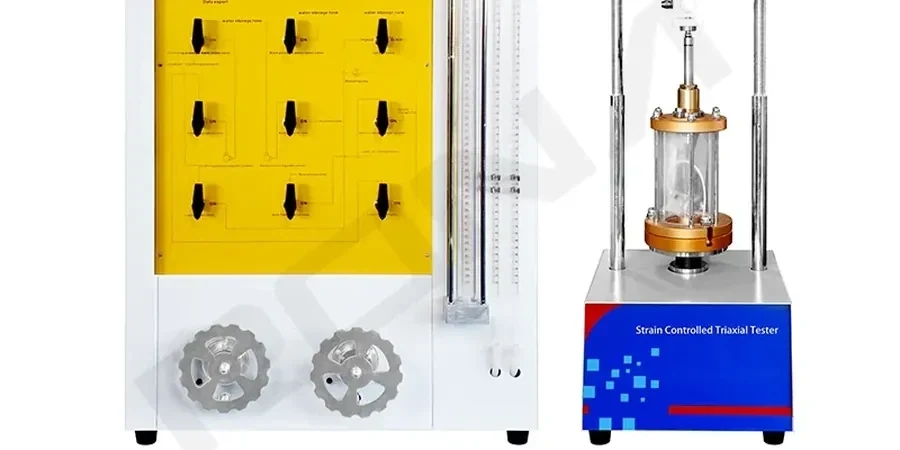
Local geotechnical conditions in Visalia
Visalia’s climate swings from bone-dry summers with 100°F-plus heat to winter atmospheric rivers that can drop 4 inches of rain in 48 hours — and that oscillation changes everything for triaxial test interpretation. During the dry season, surficial clays desiccate and crack, creating macropores that collapse on wetting; a triaxial test on a Shelby tube sample taken in August will overpredict shear strength unless the specimen is re-saturated to field capacity before shearing. Conversely, in January, the water table under Visalia’s east side can rise to within 3 feet of grade, saturating silty layers that behave drained under long-term loading but undrained during an earthquake. The effective stress cohesion intercept for these near-surface alluvial soils often drops from 15 kPa to near zero when pore pressure equalization is incomplete — a condition we catch by monitoring excess pore pressure throughout the shear stage. The NCEER liquefaction framework, calibrated for SPT-based triggering curves originally developed for Monterey County sands, must be adjusted for Visalia’s micaceous fine sands, which exhibit higher cyclic resistance than clean quartz sands at the same blow count.
Our services
Our Visalia triaxial laboratory runs three standard test protocols, selected based on the drainage conditions and loading rate anticipated for the project. All programs include a detailed geotechnical report with stress-strain curves, Mohr-Coulomb envelopes, and effective stress paths.
Consolidated Undrained (CU) Triaxial with Pore Pressure Measurement
The standard for foundation design in Visalia’s saturated alluvial clays. Three specimens are isotropically consolidated, then sheared undrained at 1% strain per minute. Effective stress parameters φ' and c' are derived from Mohr circles plotted at failure, corrected for measured excess pore pressure. This test captures the undrained strength Su for short-term bearing capacity and the drained friction angle for long-term settlement analysis.
Consolidated Drained (CD) Triaxial Test
Applied to free-draining sands and gravels encountered in the upper Kaweah fan deposits. Shearing proceeds slowly enough (0.05% strain per minute) to allow full pore pressure dissipation, confirmed by zero excess pore pressure reading throughout. The drained friction angle φ'd is the key input for slope stability modeling in Visalia’s irrigation canal embankments, where steady-state seepage governs.
Unconsolidated Undrained (UU) Triaxial Test
Rapid screening test for total stress parameters in low-permeability clay lenses. Specimens are loaded without saturation or consolidation, providing a conservative undrained shear strength Su for temporary excavation support design. We run UU series when evaluating short-term stability of trench shoring in Visalia’s downtown utility corridors, where construction timelines do not allow for full CU testing.
Top questions
What is the typical cost range for a three-specimen triaxial test program in Visalia?
A complete triaxial series — three specimens at different confining stresses, including saturation, consolidation, shear, and reporting — typically ranges from US$1,860 to US$2,710, depending on whether the program is CU, CD, or UU and the consolidation time required for Visalia’s alluvial clays.
How do you select which triaxial test type to run for a Visalia project?
The selection depends on soil type and loading conditions. For fine-grained alluvial clays below the water table, we run CU with pore pressure measurement to separate drained and undrained behavior. For free-draining sands in the upper fan, CD tests give the drained friction angle needed for long-term slope stability. UU tests serve as quick total-stress checks for temporary works in clay.
How long does a full consolidated-undrained triaxial series take from sample arrival to report?
For Visalia’s typical clayey silts, expect 10 to 14 calendar days. Saturation and B-check can take 2–3 days for low-permeability specimens. Consolidation requires at least 24 hours per stress increment; shear at 1% strain/minute to 20% axial strain adds another day. Reporting with Mohr-Coulomb interpretation and stress path plots takes 2–3 additional business days.
Can triaxial test results be used directly in liquefaction assessment for Visalia?
Cyclic triaxial tests specifically measure liquefaction resistance, but standard monotonic CU tests contribute indirectly by defining the static shear strength and consolidation characteristics. For a full liquefaction triggering analysis in Visalia’s micaceous sands, we recommend combining monotonic triaxial data with SPT-based NCEER procedures, adjusted for fines content and mineralogy.