The alluvial clays and high water table of the Kaweah River basin create a distinct challenge for underground construction in Visalia. Unlike tunneling through the granite of the Sierra foothills just 30 miles east, projects here contend with compressible, unconsolidated sediments deposited over millennia. A standard investigation simply isn't enough. Our geotechnical analysis for soft soil tunnels targets the specific failure modes that plague the San Joaquin Valley—namely face instability and excessive long-term settlement. For tunnel designers working in the valley's expansive clays, we often pair advanced lab index testing with in-situ CPT testing to establish a continuous profile of tip resistance and sleeve friction, which is critical for selecting the right shield pressure for an EPB machine before excavation begins.
Face stability in Visalia's saturated alluvium isn't a function of depth alone—it's controlled by the pore pressure regime in the interbedded sand seams.
Scope of work in Visalia
We focus on three critical parameters: the stability ratio (N-value), the pore pressure response during undrained loading, and the soil arching potential above the crown. For deeper alignments where you encounter the older Tulare Formation sediments, we integrate triaxial testing to measure effective stress parameters under saturated conditions. This data feeds directly into deformation models, ensuring the design accounts for the true compressibility of the formation and prevents the utility conflicts that often arise under Visalia's aging downtown infrastructure.
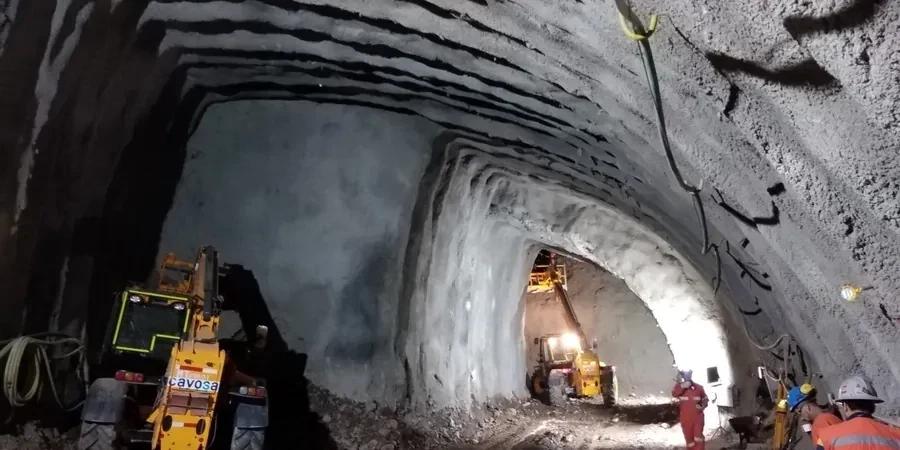
Local geotechnical conditions in Visalia
The risk profile changes dramatically between a tunnel under Visalia's industrial corridor near Highway 99 and one under the historic residential grid near Mooney Boulevard. Downtown, the soils are older and heavily overconsolidated by desiccation. Near the Packwood Creek floodplain, however, you find normally consolidated clays that can undergo significant volumetric strain as the water table fluctuates seasonally. A tunnel boring machine advancing under a high groundwater gradient can trigger a chimney failure that propagates to the surface within hours. This is why our geotechnical analysis for soft soil tunnels emphasizes pore pressure dissipation tests at multiple horizons. Without this data, the contractor is left guessing on the required face pressure, and that's when sinkholes appear in the middle of a Visalia intersection.
Our services
Our scope adapts to the tunnel alignment and the geologic unit encountered. We deliver a ground model, not just a report.
Tunnel Feasibility Geotechnical Report
Pre-design investigation covering soil stratigraphy, groundwater analysis, and preliminary face stability calculations for microtunnels and larger diameter TBMs in Visalia's alluvial basin.
Construction-Phase Ground Characterization
On-call lab testing and real-time monitoring consultation during mining. We verify the ground conditions and update the design parameters as the alignment crosses different members of the Tulare Formation.
Top questions
What is the typical budget range for a soft soil tunnel geotechnical analysis in Visalia?
Projects in the Visalia area generally range from US$4,560 for a targeted investigation on a short utility tunnel to US$19,210 for a comprehensive program covering a longer alignment with multiple boreholes, advanced triaxial testing, and a full geotechnical interpretative report.
How do you address the high groundwater table common in Tulare County?
We install standpipe and vibrating wire piezometers during the drilling phase and monitor pore pressure response over time. The data is used to calibrate seepage models so the contractor can plan dewatering or closed-face TBM operations. We also test the permeability of the sand lenses using in-situ falling head methods.
What lab tests are essential for evaluating squeeze potential in soft ground?
Consolidated-undrained (CU) triaxial tests on undisturbed Shelby tube samples are the backbone of the analysis. We also run consolidation tests to determine the compression index and oedometer modulus, which control the long-term settlement prediction for the tunnel crown.