The slipform paver inches forward on East Main Street, extruding a ribbon of concrete 12 inches thick. That slab has to resist a lot more than truck traffic. In Visalia, rigid pavement design means accounting for San Joaquin Valley clay that swells when it rains and shrinks during the long dry season. A pavement joint layout that works in coastal California won’t survive summer here. The daytime high hits 100°F regularly from June through September, and that thermal gradient loads every panel with curl stress. Before the paver ever fires up, our technicians run grain-size analysis on the subgrade and check the plasticity with atterberg-limits. Without that data, you’re guessing on the modulus of subgrade reaction. We don’t guess. We correlate everything back to AASHTO 93 and the PCA method, then adjust for the actual soil on your parcel.
A rigid pavement in Visalia fails first at the joints. Control those, and the slab handles the rest.
Scope of work in Visalia
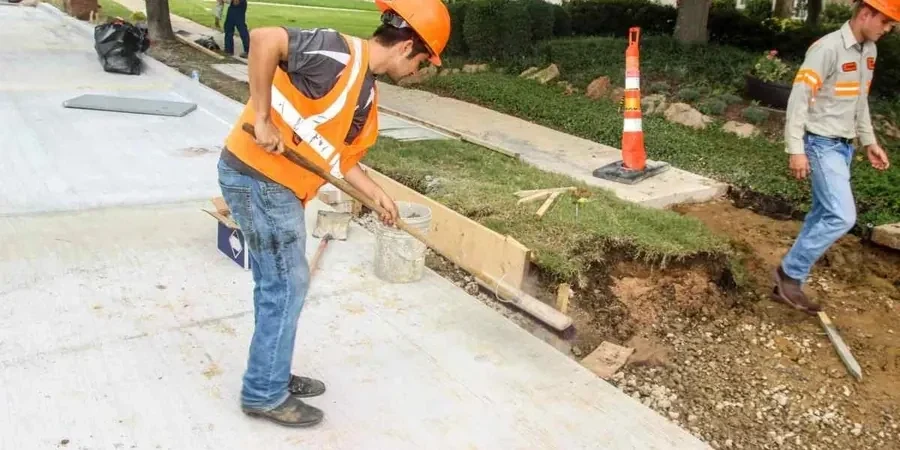
Local geotechnical conditions in Visalia
The Pleistocene alluvium under Visalia isn’t uniform. You can hit sandy lenses near the St. Johns River and fat clay just half a mile west. That variability creates differential heave, and differential heave cracks rigid pavement at the corners. We’ve pulled cores on five-year-old industrial pavements that lost 40% of their load transfer efficiency because the subgrade swelled unevenly under the slab edges. Another risk that gets overlooked: alkali-silica reaction in the aggregate. Central Valley river rock has reactive silica in some deposits. Without petrographic testing or a proper fly ash blend, the concrete can map-crack internally and lose stiffness long before the design life expires. The water table sits shallow in winter near the Kaweah River floodplain, which softens the subgrade and cuts the k-value in half during the wet months. A rigid pavement designed for summer conditions alone will pump fines at the joints come January.
Our services
We handle rigid pavement projects from the initial soil investigation through joint detailing and construction oversight. Two core service areas define our approach in Visalia.
Concrete Pavement Thickness Design
AASHTO 93 and PCA method calculations based on site-specific k-value, 30-year ESAL projections, and concrete flexural strength. We verify subgrade stabilization requirements using plasticity index and sulfate testing, then generate joint layout plans that account for Visalia’s summer-to-winter temperature swing.
Subgrade Evaluation and Treatment Specification
Field CBR, grain-size distribution, and Atterberg limits on samples taken from your exact building pad or alignment. When PI exceeds 25, we specify lime or cement stabilization depths and percentages, then verify compaction with nuclear density testing before the base course goes down.
Top questions
How much does rigid pavement design cost for a project in Visalia?
For a typical commercial or industrial project in Visalia, rigid pavement design works range from US$2,060 to US$6,620 depending on the slab area, number of soil borings required, and whether joint detailing for heavy forklift or truck traffic is included.
What subgrade problems affect rigid pavement in Visalia the most?
Expansive clays with plasticity indices above 25 are the main issue. These soils swell when the winter rains come and shrink during the long dry summer, creating uneven support under the slab. We specify lime or cement stabilization when the PI crosses that threshold.
How do you determine joint spacing for Visalia’s climate?
We start with ACI 330.1 guidelines and then tighten the spacing based on the local temperature differential. In Visalia, where summer placement temperatures can exceed 100°F and winter service temperatures drop near freezing, we typically use 12-foot joint spacing to control curl stress and prevent mid-panel cracking.